Site map

A History of Preston in Hertfordshire
Contiguous DNA relationships
Contiguous by Bren Unwin

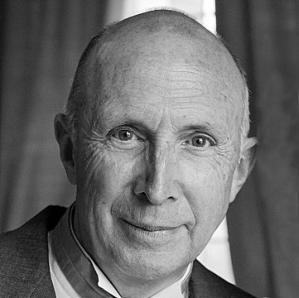
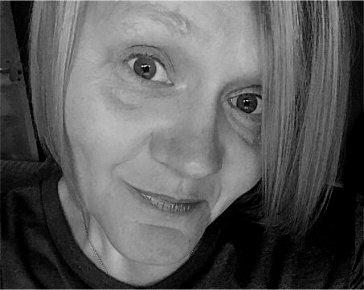
Bren Unwin of Preston Green
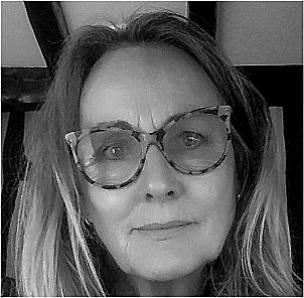
Sarah Anne Tyler of Tewin, Herts
Philip Wray, Preston History, Herts



This is a saga of discovery.
Bren Unwin first wrote to me in 2013. She was in the process of changing the name of her new home
at Preston Green. Bren wondered whether there was any reason not to go ahead with her plans.
We met briefly in 2015 when I was selling copies of A History of Preston in Hertfordshire from beside
the well at Preston Green. I was with my daughter, Colette when I next saw Bren. I was giving Col a
tour of the village. We passed Joyner’s Cottage and were kindly invited inside.
It transpired that we both had ancestors who lived in the village of Tewin in Hertfordshire. Bren was
descended from the Perry family who lived at Lower Green. My greatx 2 grandparents, Robert and
Jane Wray, were born at Tewin in the 1780’s. They married and brought up their children there at
Upper Green.
Not surprisingly, newspaper reports revealed that the Perrys and the Wrays knew each other:
I then browsed Tewin records to see if there were any other connections between the two families -
such as being witnesses at weddings - but found nothing.
And there the matter lay - until the evening of 27 November 2025.
Curiosity often leads to browsing the internet - when being occasionally playful, the goddess
Serendipity smiles benignly on the searcher. For the first time in several months, I idly checked my
DNA matches at Ancestry.co.uk. I entered ‘Tewin’ to see how many of my matches had connections
to the village. There was but a handful. I then added the surname ‘Perry’ to the search - not expecting
to find ‘a hit’. But there was one match - to a Sarah Tyler who was born in 1972 and was living in
Hertfordshire. I quickly found her address as Upper Green Road, Tewin.
This is a stone’s throw from the house in which my Wray ancestors lived. Sarah is obviously
interested in her ancestry because she added a well-researched family tree. It was then that an
almost incredible fact became apparent. In her tree was a Wray and a Perry. She had descended
from both families:
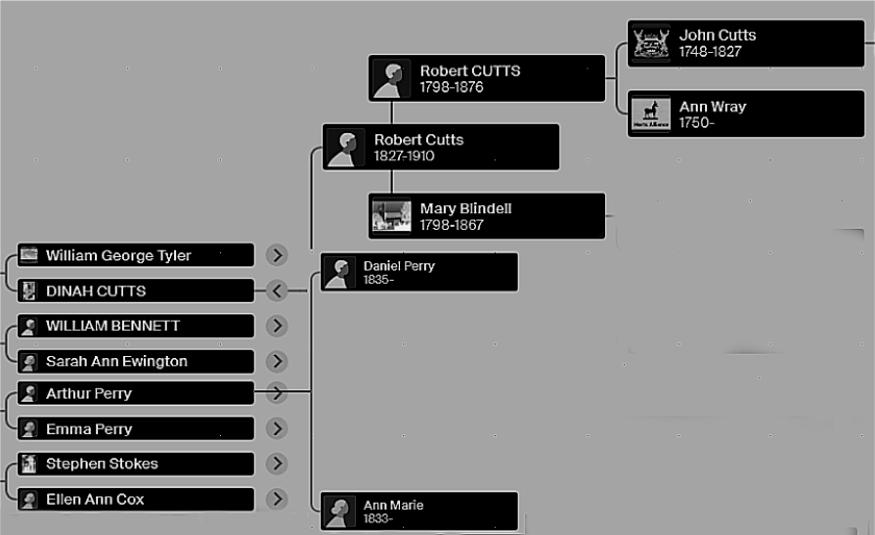
Shown above is Sarah Tyler’s abbreviated tree. It includes her ancestors, Daniel and Ann Marie Perry
(who are Bren’s greatx 2 grandparents). Ann Wray was also included. She was the daughter of my
greatx4 grandparents, Henry and Anne Wray, which means that they are Sarah’s greatx5
grandparents. This is corroborated by the match between Sarah and myself which is a low 10 cMs
(centimorgans - a measure of DNA)
The Tylers have lived at Tewin since at least 1791 (when Joseph Tyler was born there). Between
2011 and 2017 fifteen adult Tylers were living in the village at seven different addresses. The Perrys
and the Tylers were often reported together in newspapers either for petty crimes or local
competitions, such as the following, from November 1884.
This article demonstrates the power of DNA genealogy to reveal historical connections that
documentary evidence alone cannot establish. Of how two unrelated families living cheek by jowl
150 years ago, networked together in a way that transcended formal kinship because their DNA
converged in one woman, Sarah Tyler of Tewin, Herts.
Sarah shares DNA segments of two people that are contiguous though from separate family lines.
In genetic genealogy, “contiguous” describes two distinct DNA segments that sit immediately next
to one another on the same chromosome in a descendant. The join between them marks the
physical point where recombination in an earlier ancestor brought together DNA from the two family
lines that Sarah inherits.


Intermediate Conclusion

This discovery demonstrates what DNA genealogy can reveal when documentary evidence reaches its
limits. Two unrelated families, the Perrys and the Wrays, lived in Tewin in the nineteenth century and
clearly knew each other—newspaper records confirm this beyond doubt. Yet no blood relationship
connects them (or so I thought when I first wrote this).
Over 150 years later, a routine DNA search uncovered something remarkable: Sarah Tyler bears
genetic material from both families. The segments of DNA she shares with Bren and myself are
contiguous - unbroken stretches inherited from common ancestors. Yet they arrived through entirely
separate family lines. She stands as tangible proof of the social networks that bound Tewin together,
networks that transcended formal kinship and remained invisible until modern genetic science made
them visible.
This convergence of meticulous family history research, DNA testing, and historical documentation
demonstrates what becomes possible when these tools work in concert. It offers a compelling model of
how local history can be recovered and understood in the twenty-first century.


COUNTY MAGISTRATES, Jan 18. James Presland and Charles Wray were charged with stealing a
mattock, the property of Mrs. Cannon, of Tewin. — P.C. Hill said: On the 11th inst. I received
information from Mrs. Cannon that the mattock was stolen: went to Wray and asked him where his
tools were, and he said “behind some bushes:” went there, but did not find the one missing: soon
after word was sent to me from Welwyn police office that if I examined the ground I should find the
mattock: I went to the place stated, looked, and found it buried in the ground.
I went to a field at Tewin-bury and charged Presland with stealing the mattock; he said he found it
in a field, covered with grass, and James Perry was with him at the time: went to Perry and he said
he had never been in company with Presland in his life when a mattock was found. — Wray said he
bought it of Presland and he had had it about two months. — Mr. Cannon said, they lost it about the
5th of Nov, and he identified the one produced by a certain mark. — Presland said, he found the tool
in a warren, covered with bushes, and Wray said, they always hid their own tools at night when
they left off work. — P.C. Hill said, the other tools were covered with thorns or long grass, but this
mattock was buried in the ground. There was no direct evidence against the men, and the bench
dismissed the case: it was however a very proper one for investigation.
COUNTY MAGISTRATES, Dec. 3. — Geo. Perry and Robt. Wray, of Tewin, were charged with
trespassing in search of game on land belonging to Earl Cowper, in the parish of Tewin. Chas.
North, a lad employed by Mr. Day, of Tewin, said, that about 7 a.m. on Wednesday, Nov. 23rd, he
was at his master’s, heard a gun go off, saw Perry and Wray jump a fence, and the former stoop
and pick up three or four somethings; he was about 100 yards off. — Mr. Armstrong, who defended
Perry, after speaking of the “pert” manner in which the boy gave his evidence, and of its
unsatisfactory manner, &c., explained that Perry’s brother fired off the gun at his own house. The
bench, without hearing witnesses for the defence, dismissed the case.
28 January 1862
13 December 1864
Charles Stoker, Henry Jackson, Thomas Perry, and Joseph Tyler, all of Tewin, were summoned by
Mr. R. S. Knapman, the landlord of the Cowper Arms, Welwyn Railway Station, for being drunk
and disorderly on Sept. 4th. Mr. Barker, solicitor, of Hitchin, prosecuted, and Mr. Wells, of St.
Albans, was for the defence.
Matthew Reeves, ostler for Mr. Knapman, stated that on Thursday evening, Sept. 4, about 7 o’clock,
the four defendants drove up to the Cowper Arms in a cart, and one of them called for a quart of ale.
Witness took it out to them, when one of them asked him to pour it out. He poured a glass out and
handed it to Tyler, who tried to throw it over him. Witness poured another glassful out and he drank
part of it. Perry then got up from the bottom of the cart and asked for the ostler. Witness told him
that he was the ostler, and Perry then said “You are the — that helped to put me out the other day.”
Witness said “Yes, I was there.” All four defendants then got out of the cart and stripped. Witness
said “Stop, you have not paid for the ale yet.” Tyler then gave him a shilling to pay for it, and he took
the jug and glasses into the house and went back and gave him sixpence change. All four defendants
then got round him and tried to strike him, but he ran up the yard and tried to fasten the gates, but
they forced their way through and ran after him and threw stones and pieces of wood at him. He
ran into the stable and fastened himself in, when Stocker went to the window with a large piece of
wood (produced). Witness remained in the stable until he thought the defendants had gone. They
were all drunk. Witness helped to put Perry out the previous Thursday
A further discovery

I first started taking an interest in DNA in June 2022. There is an article, ‘My DNA test and Preston’
on this website (Link: DNA).
Since that time I have studied DNA genetic research, taking two Pharos courses about the subject
and other courses such as those which come under the umbrella of ‘My DNA Guide’. I’ve also had a
steep learning curve of practical experience attempting to find the identity of people’s ancestors. In
the last two months, after three years, I found the father of an adoptee which was confirmed by DNA
testing. This was an emotional and life-changing event for several people. Along the way, I learnt that
this journey is not completed in ten minutes (which may be the impression given by TV DNA shows)
but there are several hurdles to overcome. In this particular case, the surname of the father was
unusual, which meant that only a couple of close family members had taken the test. As a result,
there was little to go on for a significant breakthrough of DNA matches to be made.
So, there we were on 27 November 2025 as described above. We knew of one person linking Bren
Unwin and myself but not as being related. She only shared our DNA. Sometimes, when working on
a family history or solving a DNA puzzle, the searcher may have an intuition about a relationship. This
is possibly because what is called ‘intuition’ are actually clues which have been found but their
importance has not been fully understood. As a result they slumber in one’s mental filing cabinet until
an awakening.
This is exactly what happened on 28 November 2025. I awoke with a clear sense that in view of what
I had found there must be a connection between the Wray and Perry families. All that was needed
was for the hard work of detective work to begin.
At least a half of DNA research involves drawing family trees. These are trees which go back in time
and then forward to find living relatives whose DNA is shared with the subject. It is painstaking and
meticulous work. All the family’s ancestors and their descendants have to be found and their
relationship to the subject calculated. There is also the problem of putting two people together at the
same time and place for a child to be conceived. If anyone is missed, Murphy’s Law says he or she
could be the key to solving the problem.
So, on the morning of 28 November, I began investigating the children of my grtx3 grandparents,
Henry and Anne Wray who were born in around 1718. They had children in Hatfield, Herts. My
reasoning was that their children could have been connected to the Wrays and Perrys who were at
Tewin, Herts from 1747 to 1850. I spent the whole of the day immersed in constructing family trees -
a slog of a job.
I failed to find a link. I now know that the reason was that the connection was a generation closer
than I had computed by a generation.
Unknown to me, Bren was looking at her Perry family tree on that same day. Ancestry has a tool
which projects potential ancestors of DNA matches using the family trees of its clients which are
stored in its records. It is called ‘Thrulines’. However its suggestions may be flawed because many of
these trees are inaccurate. Therefore, the named ancestor is possibly a mistake.
On 29 November at 10.08, Bren sent me a screen-shot of her Ancestry-projected family tree.
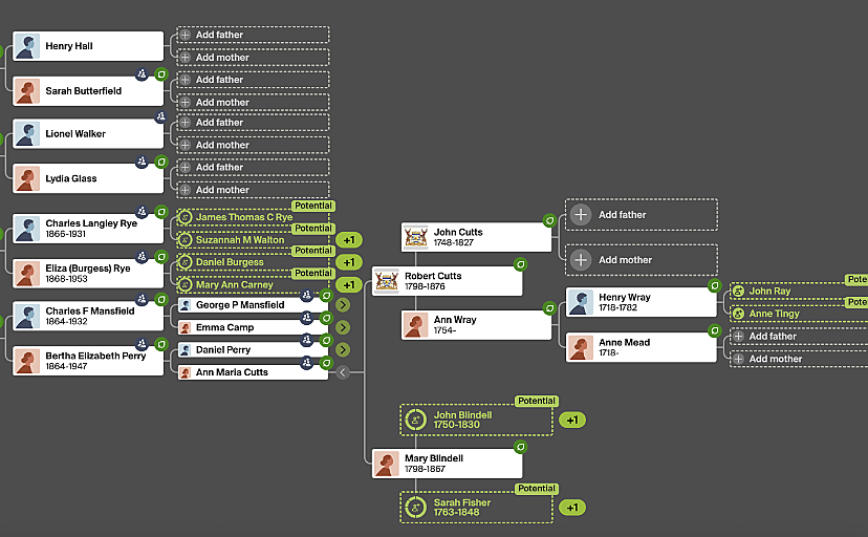
If the reader looks to the right of the tree, they will see what caught my attention. Henry and Ann Wray
were in her suggested tree. I emailed back, ‘ You do realise what you have sent here?’ Answer: ‘No, I
don’t think I do’. Reply, after checking the Cousin’s Relationship Chart: ‘We are related. We have
common ancestors. We are fifth cousins once removed’. Bren, ‘Hello Henry, Hello Anne. Thank you,
cousin’.
I checked the Wray family tree on the Preston History website. This had been assembled at least
twelve years ago. (Link: Wray tree). The children of Henry and Anne Wray were displayed here. Their
daughter, Ann Wray, married John Cutts at Tewin in 1772 just as Bren’s family tree also displayed. I
had been beaten in the race to find a common ancestor.
Now, an important question: both Bren and I have tested with DNA Ancestry at different times and
unknown to each other. Why did neither of us see a DNA match with the other?
Fifth cousins once removed are separated by six generations. There is a limit to the time range
included in Ancestry’s autosomal DNA test results. DNA matches of less than 7 cMs are not listed. A
gap of six generations is on the cusp of inclusion.
This means that there are two separate family trees that can be drawn. They are the genealogical
tree (which is based on the recognised method of collecting births data to show lines of ancestry).
Secondly, there is the genetic tree (which are complied using DNA matches). If there is a difference,
it is always the genetic tree which is correct - the DNA trail cannot lie.
In this case, other DNA matches confirm the conclusion that Bren and I are related.
Welcome to the family, Bren!
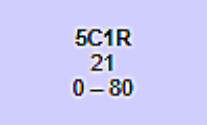
This block has to do with the DNA associated with a fifth
cousin once removed and has been taken from the free on-line
tool, DNA Painter. It shows that those in that relationship have
an average DNA match of 21 cMs. Crucially, the range of DNA
is from 0 to 80 cMs
As the block shows, it may be that Bren and I do not have any common DNA - but the genealogical
evidence is clear.
Our story begins with a letter. Bren first wrote to me in 2013. She was in the process of changing the
name of her new home at Preston Green. Bren wondered whether there was any reason not to go
ahead with her plans.
We met briefly in 2015 when I was selling copies of A History of Preston in Hertfordshire from beside
the well at Preston Green. I live in Wales and so I next saw Bren when I was with my daughter,
Colette. I was giving her a tour of the village in October 2025. We passed Joyner’s Cottage and were
kindly invited inside.
It transpired that we both had ancestors who lived in the village of Tewin in Hertfordshire. Bren was
descended from the Perry family who lived at Lower Green. Bertha Perry, her great-grandmother, was
born there in 1864. My 2x great-grandparents, Robert and Jane Wray, were born at Tewin in the
1780s. They married and brought up their children there at Upper Green. Newspapers reported
Perrys and Wrays appearing together before local magistrates.
By late November 2025, I had sensed that, in view of what had been found, there must be a
connection between the two families. Whilst I researched the Wray family tree, unknown to me Bren
was independantly looking at her Perry ancestry. She had also taken a DNA test and together we
were able to link the two families back to common ancestors, Anne and Henry Wray. The couple were
Bren’s and my 4x great-grandparents. We are therefore fifth cousins, once removed (5C1R).
However, both Bren and I have tested with Ancestry DNA, why did neither of us see a DNA match
with the other? 5C1R are separated by six generations. There is a limit to the time range included in
Ancestry’s DNA test results. Platforms often filter out very small segments (commonly below about 7
centimorgans).
While the average shared DNA for that relationship can be around a couple of dozen centimorgans,
the range includes zero—meaning two genuine relatives may share no detectable DNA. In our case,
other matches in the wider network support the conclusion reached from the records. DNA matches of
less than 7 cMs are not listed. A gap of six generations is on the cusp of inclusion.
(Photos of Bren and That Bloke - Smaller???)
This means that there are two separate family trees that can be drawn. They are the genealogical tree
(which is based on the recognised method of collecting births data to show lines of ancestry).
Secondly, there is the genetic tree (which are complied using DNA matches). If there is a difference, it
is always the genetic tree which is correct - the DNA trail cannot lie, although it can be misinterpreted.
In this case, other DNA matches confirm the conclusion that Bren and I are related.
Welcome to the family, Bren!
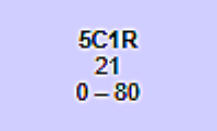
This block has to do with the DNA associated with a fifth cousin once
removed. It shows that those in that relationship have an average DNA
match of 21 cMs. Crucially, the range of DNA is from 0 to 80 cMs.
As the block illustrates, it may be that Bren and I do not have any common
DNA - but the genealogical evidence is clear.
Note to Bren - May I humbly suggest that if the block is included (which you indicate in your
revision (for want of a better word) the figures should be included to make sense of why they are
commented on - Uriah Heep
Possibly all we’ve discussed is included here. I’m pretty happy with this - hope you are, and any
changes you want can be easily slotted in. I’ve run it thru two AI programs. It suggests a few
minor tweaks which seem reasonable - a change to the introduction and an explanation of why
we didn’t see each other for ten years. It also strongly recommends an explanation of why there
are no DNA matches of us. Please don’t dismiss this because its from AI . I think its reasonable.
Maybe give it a chance?
I’ve tightened up the writing a little. You will be gratified to know that the reading time comes in
at 16 seconds, give or take (actually, a lot of taking :-)) .